Fluency Session: Structure
Where the Major & Minor Integrate
Ascending 1 - 3 - 5 | Shift on 3b
Simple pattern exercise that unfolds the structural correlations between the Major, Relative Minor (Natural), and the Parallel Minor to the Major.
Begin | Determine Your Initial Position
Place your hand so that you can sound two notes, a fifth apart.
- On keys (image), this could be a C and G.
- On guitar, a simple power chord, E and B.
- Cello/Vio: two adjacent open strings - your choice
- Winds/Brass: Pick a starting note and sound its fifth (above)
Example: Eb to Bb (sax, etc), C to G (trumpet)
Find the Major Triad
Maintain the shape of the fifth and add the major third
- Keys: C E G
- Guitar: E G# B
- Cello: G (on C) B (on G) D (open)
Stretch... 🙂 - Vio: D (on G) F# (on A) A (open)
Yes, there is reason string instruments play inversions, but for the sake of this exercise, keep the tonal order and center - Winds: Eb G Bb
- Trumpet: C E G
Flat the 3rd
Move the third down a half step
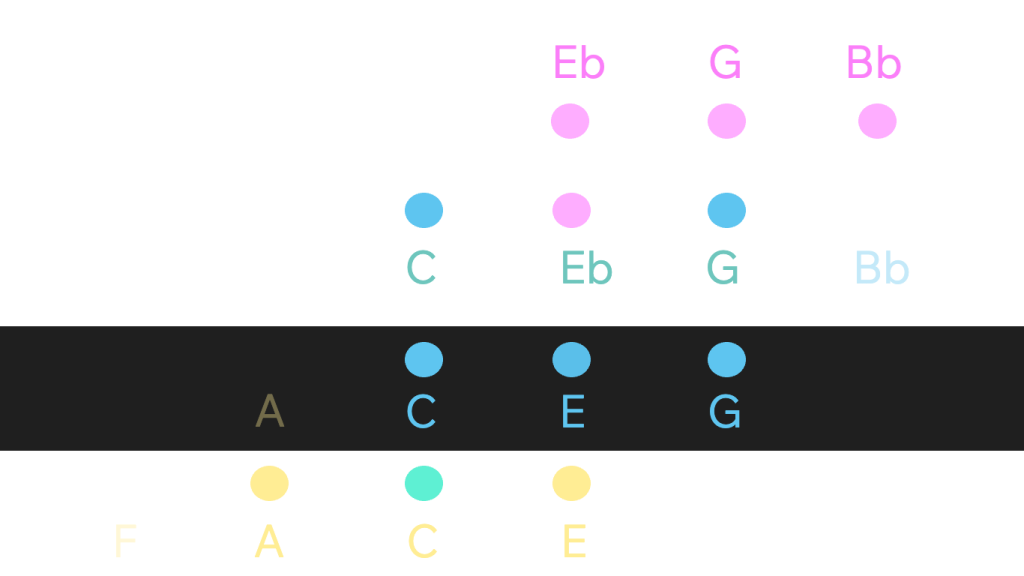
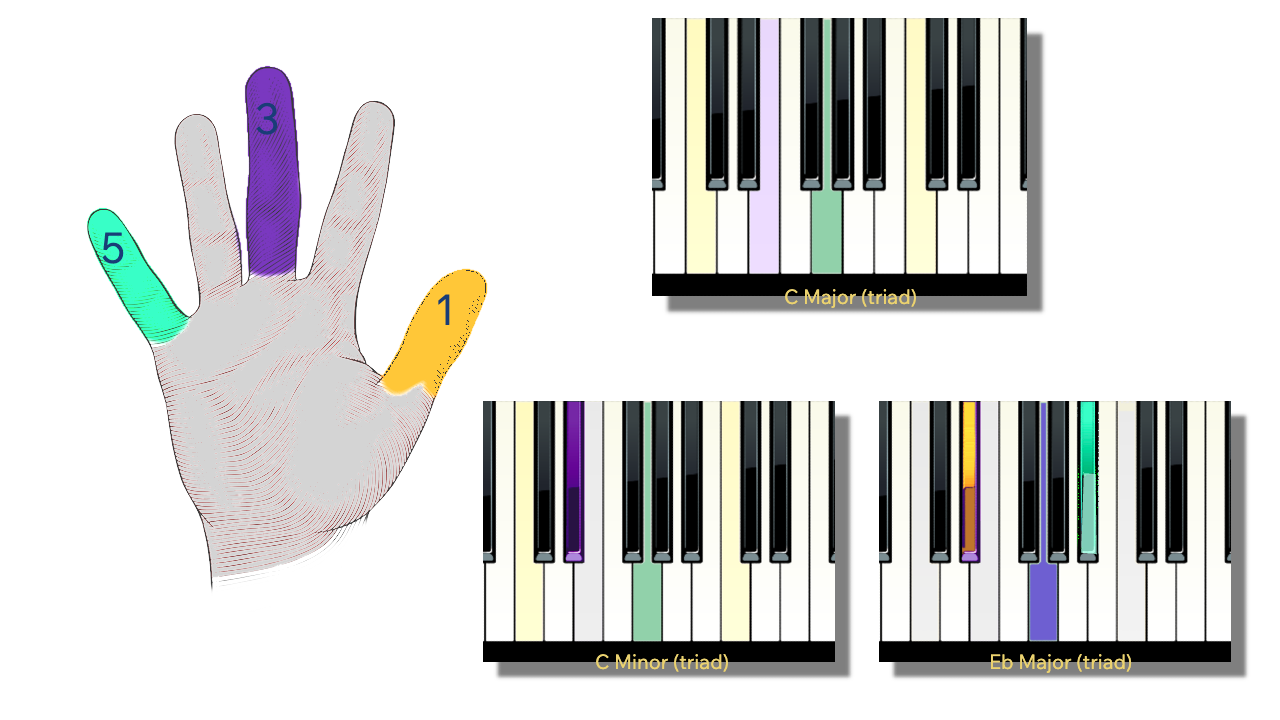
C E G becomes C Eb G
E G# B becomes E G B
G B D becomes G Bb D
D F# A becomes D F A
Eb G Bb becomes Eb Gb Bb
Shift the Tonal Center
What was the 3 became the flat 3, or 3b
Now that 3b becomes the new 1 (shift the tonal center)
When began with the major triad C E G
1=C 3=E 5=G
Here, the tonal center is C
Then we dropped the third by a half step C Eb G
1=C 3b=Eb 5=G
Here, the tonal center is C, and that C has taken on a natural minor flavor
__________________________
Now we will shift the existing 1 to its new position, the existing 3b
What was 1=C, is now 1=Eb
With our new 1 (Eb) determined, we resume our major triad shape (1-3-5), beginning this time on Eb
1=Eb 3=G 5=Bb
Eb G Bb
The tonal center has become Eb
Guess what, you can repeat this in however many iterations you'd like, simply by moving through the steps, ascending in pitch.
Want to know how it works descending in pitch? Check out the next tab.
video coming soon
Descending 5 - 3 - 1 | Shift to the third below (same note as the 6th)
Simple pattern exercise that unfolds the structural correlations between the Major, Relative Minor (Natural), and the Parallel Minor to the Major.
Begin | Determine Your Initial Position
Place your hand so that you can sound two notes, a fifth apart.
- On keys (image), this could be a C and G.
- On guitar, a simple power chord, E and B.
- Cello/Vio: two adjacent open strings - your choice
- Winds/Brass: Pick a starting note and sound its fifth (above)
Example: Eb to Bb (sax, etc), C to G (trumpet)
Find the Major Triad
Maintain the shape of the fifth and add the major third
- Keys: C E G
- Guitar: E G# B
- Cello: G (on C) B (on G) D (open)
Stretch... 🙂 - Vio: D (on G) F# (on A) A (open)
Yes, there is reason string instruments play inversions, but for the sake of this exercise, keep the tonal order and center - Winds: Eb G Bb
- Trumpet: C E G
Shift the Tonal Center
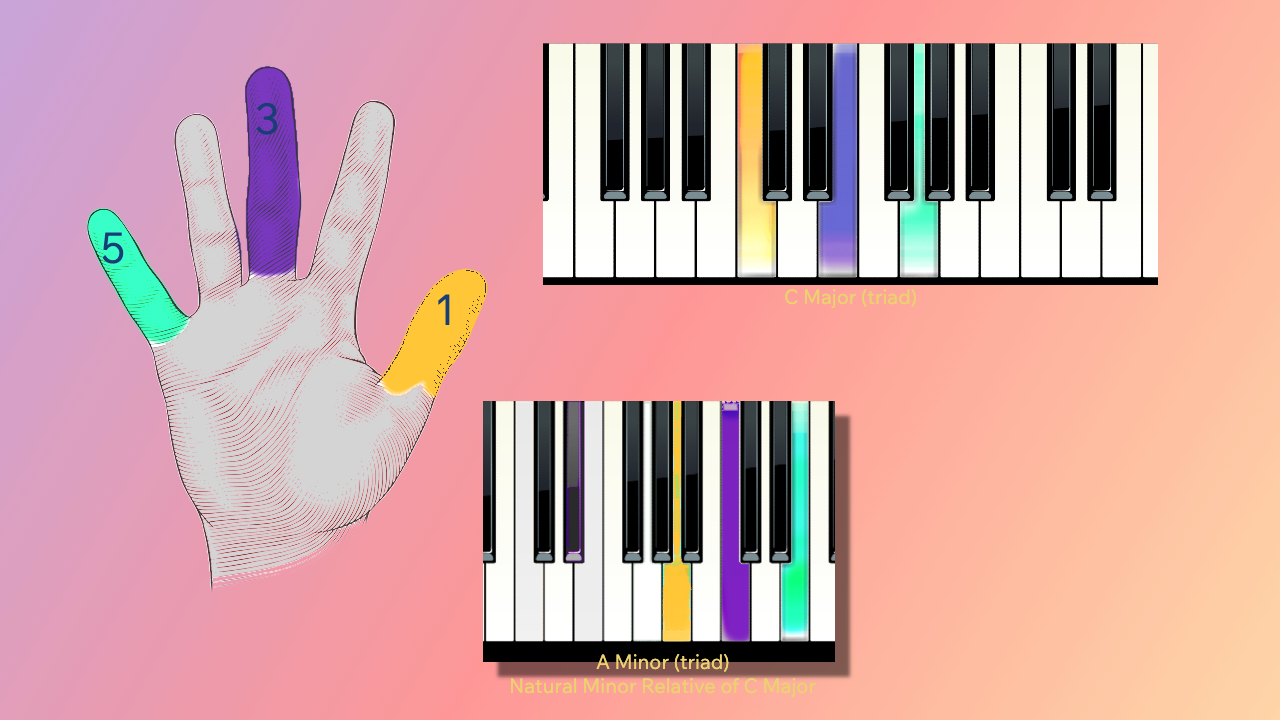
What was the 5 shifts now to what was the 3. We can also say what was the 1, drops a third to its new position (C to A below)
C E G was previously 1=C 3=E 5=G
Now E=5, C=3, and A=1
Shift the tonal center from C to A
_______________________________
We began with the major triad C E G
1=C 3=E 5=G
Here, the tonal center is C
Then we dropped the shape (1-3-5) down a third
C moves to a third below, A
E moves to C
G moves to E
We now have:
1=A 3=C 5=E
The tonal center, our anchor, becomes A
and it has taken on a natural minor flavor
__________________________
C Major has the same ingredients, the same sharps/flats, as the key of A Minor (Natural). They are relatives (cousins).