

Fluency in Music
Our most natural state of learning comes from observing, absorbing, experimenting, and exploring. We seek out responses, we attempt to share our thoughts and feelings, and crave the interaction and exchange. Thought after thought, strung together in a harmonic sequence of one moment to the next, recognizing the space between here and when, there, and then.
Core Principles of Musical Fluency
Fluency is understanding music from the inside. Where construction replaces memorization, and comprehension becomes function.
Where genre, instrument, and experience blend into the stories held within the harmonies, created spontaneously together and in our own space.
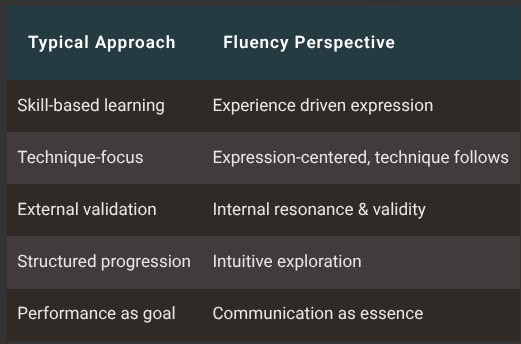
|
Typical Approach
|
Fluency Perspective
|
|---|---|
|
Skill-based learning
|
Experience driven expression
|
|
Technique-focus
|
Expression-centered, technique follows
|
|
External validation
|
Internal resonance & validity
|
|
Structured progression
|
Intuitive exploration
|
|
Performance as goal
|
Communication as essence
|
UngatekeepingMusic
Music Belongs to Us All
Piano
Piano Centered Instruction, Exploration
~ All Instruments & Experience Levels Welcome ~
Acoustic, Digital, Synth
Thursdays Online – 4pm Mountain/UTC-6
Structure of Music
Theory, Structure, Mapping Music
~ All Instruments Welcome ~
Thursdays Online – 7pm Mountain/UTC-6
Composition, DAW, and Arrangement Fluency
~ Dice Roll Series ~
~ Discussion Group ~
Meeting Times by Request
We sat to the keys and just started playing. I offered her a foundation and she draws her stories all through the scene. Then she takes the lead and I step into her current.
Holding conversation in music is a form of expression available to us all
Curious? Agree? Skeptical? What if developing your fluency with music could be filled with joy and ease, discovery and magic?
The Fluency Perspective: Reimagining Musical Experience
When we move from the contrived expectation, and return to listening from within our being, we remember our very first language, the language of energy in motion. We can share our thoughts and feelings, and create incredible stories within those frequencies.
Music is humanity’s language of intuition and understanding, and it is energy’s voice, sharing the tales of being.
It can be explained through scientific principles (start with wave theory), visualized through math, but ultimately, music is a conversation we share, a story we spin, a memory held and preserved, carried from one generation to the next.
Language is for expression. Music transcends culture, is unhindered by borders, and suspends our legacy in space, reaching through time.
Stepping into the flow of the experiences of life, your instrument becomes a conduit for your story to be heard. Music is a method of communicating, able to be understood by all humans.
Music is our first language. We begin listening, responding, and correlating experiences and music, even prior to birth; we felt and experienced our own mother’s response to music.
Fluency in Music comes just as fluency in any language, with immersion, opportunity, constructive response, and a safe place to explore and create the mental connections needed to be able to comprehend and converse.
The music is the wind that forever moves us, carrying us to where we’ve yet to be, and returns us to where we know we are. Listen.
Where the only box – is the one in your hands, resonating with a pulse and breath, and a voice of its own